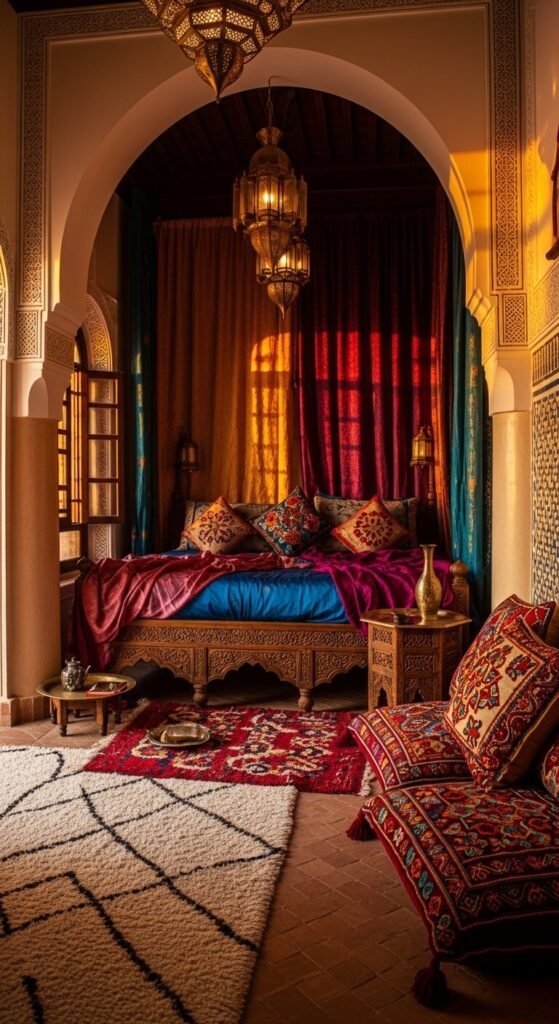
Walking into a Moroccan-inspired bedroom feels like stepping through a portal — warm light filters through ornate lanterns, rich fabrics pool across low beds, and every surface tells a story of craft and culture. This style draws from centuries of artisan tradition rooted in North Africa, and it doesn’t ask for a big budget or a complete renovation. Whether you’re starting from scratch or refreshing what you already have, these 28 elements will help you bring that faraway warmth into your own four walls. Each one is practical, affordable, and deeply atmospheric. Start with one. The room will do the rest.
1. Carved Wooden Headboard
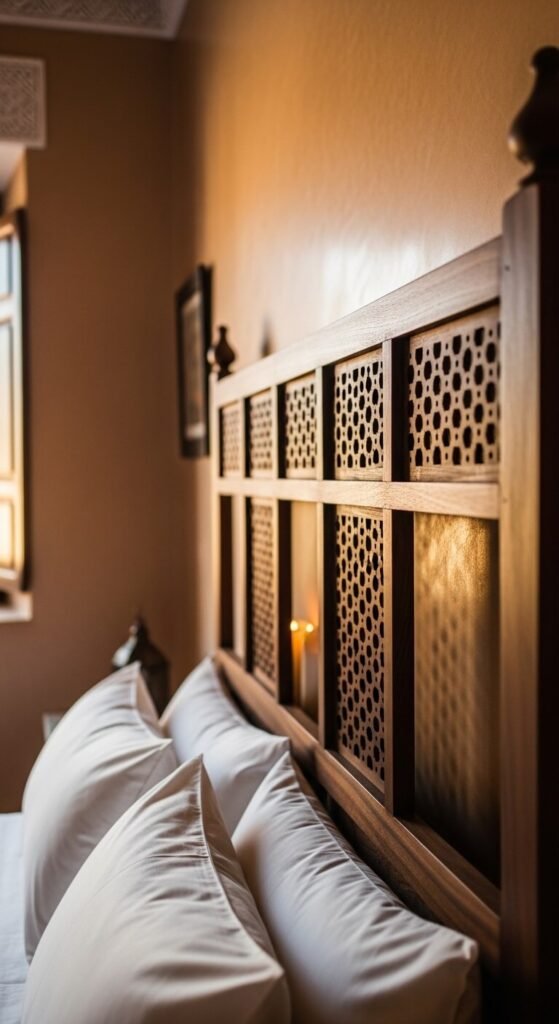
A carved wooden headboard is a statement on its own.
Look for headboards with geometric cutout patterns — diamonds, stars, or arabesques. These are the shapes Moroccan craftspeople have used for generations. You don’t need to spend a fortune. Secondhand furniture shops and online resale platforms regularly carry carved wood pieces at low prices. Sand it down, stain it dark walnut or ebony, and you have something that looks custom. Mount it directly to the wall if you don’t have a bed frame. The carved silhouette against a plain wall is powerful all by itself.
2. Zellige-Inspired Tile Accent Wall
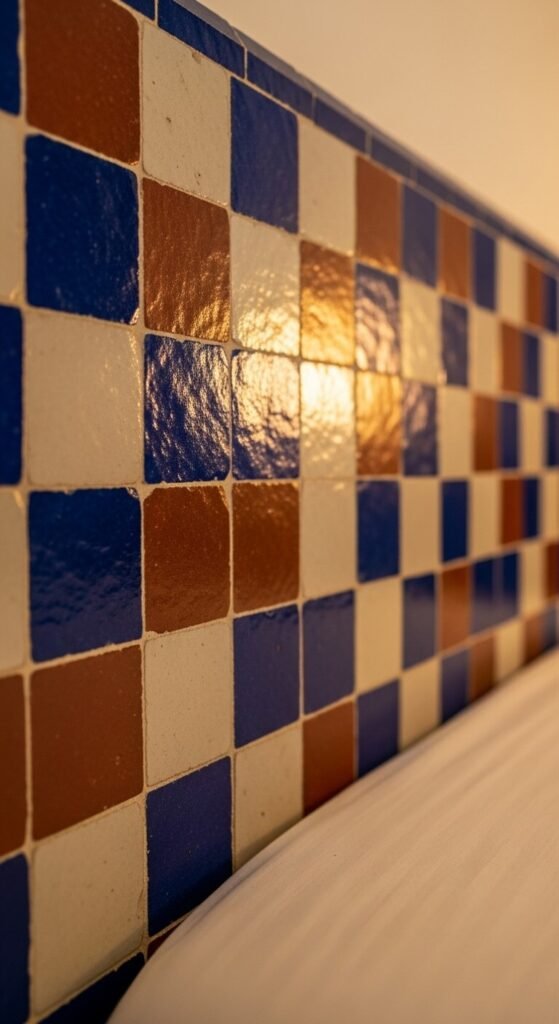
A tile accent wall instantly signals Moroccan design.
Zellige tiles are small, hand-cut, and slightly uneven — that imperfection is the whole point. You don’t need to tile an entire wall. Even a 3-foot section behind the headboard makes a dramatic impact. Peel-and-stick tile panels in zellige-style patterns exist at most home improvement stores and online retailers for under $30 per sheet. If you want the real thing, Moroccan import shops sell authentic zellige starting around $8 per square foot. Keep the surrounding walls neutral to let the tile breathe.
3. Hanging Brass Lanterns
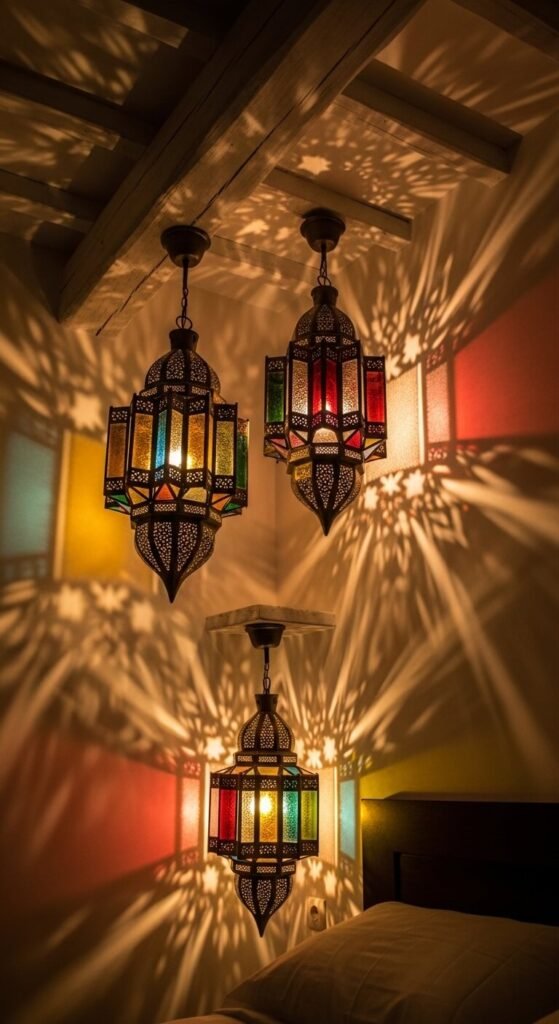
Lighting is where the magic truly lives in a Moroccan bedroom.
Pierced brass lanterns throw patterns of light across walls and ceilings that no other fixture can replicate. Hang one large lantern as a focal point, or cluster three at different heights for a dramatic canopy effect. Etsy and World Market carry authentic-style options from $25 to $80. For a DIY version, buy a plain metal pendant and wrap it in a laser-cut brass sleeve — tutorials are widely available online. Use warm-toned LED bulbs (2700K) to get that golden, fire-lit quality.
4. Layered Kilim Rugs
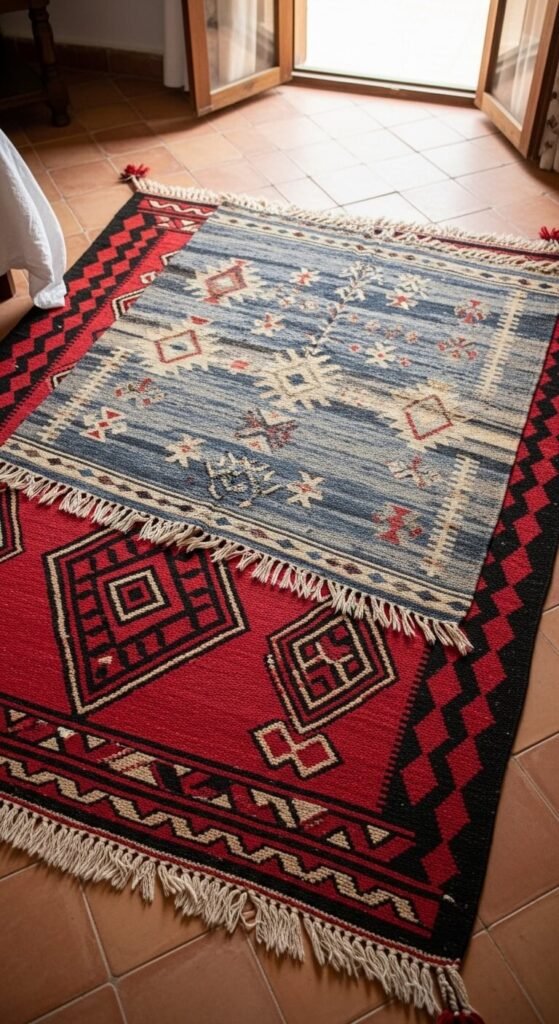
Layering rugs is one of the easiest Moroccan tricks in the book.
Start with a large, flat-weave kilim rug as your base — these are typically more affordable than pile rugs and come in rich geometric patterns. Then layer a smaller Beni Ourain-style rug (cream with black diamond marks) on top, offset slightly for depth. IKEA, Overstock, and Amazon carry kilim-pattern rugs starting around $45. Real vintage kilims from eBay or Turkish import shops can run $80–$200 but last decades. The layers create visual richness without requiring expensive furniture.
5. Low-Platform Bed Frame
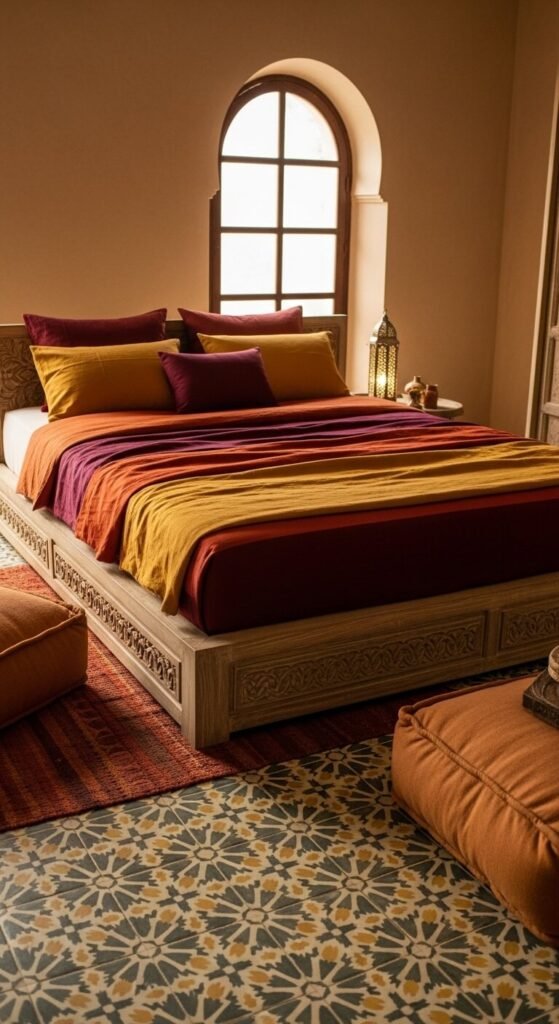
Getting low is a key Moroccan move.
Traditional Moroccan sleeping spaces keep beds close to the floor. A low-platform bed frame creates that grounded, intimate feeling immediately. IKEA’s MALM and similar low-profile frames work perfectly as a base. Add carved wood side panels or fabric side drapes to give it a more artisan look. If you’re on a tight budget, skip the frame entirely. Place your mattress directly on a simple wooden pallet painted dark espresso. Pile on the pillows and textiles, and the bed becomes the room’s entire story.
6. Jewel-Tone Color Palette
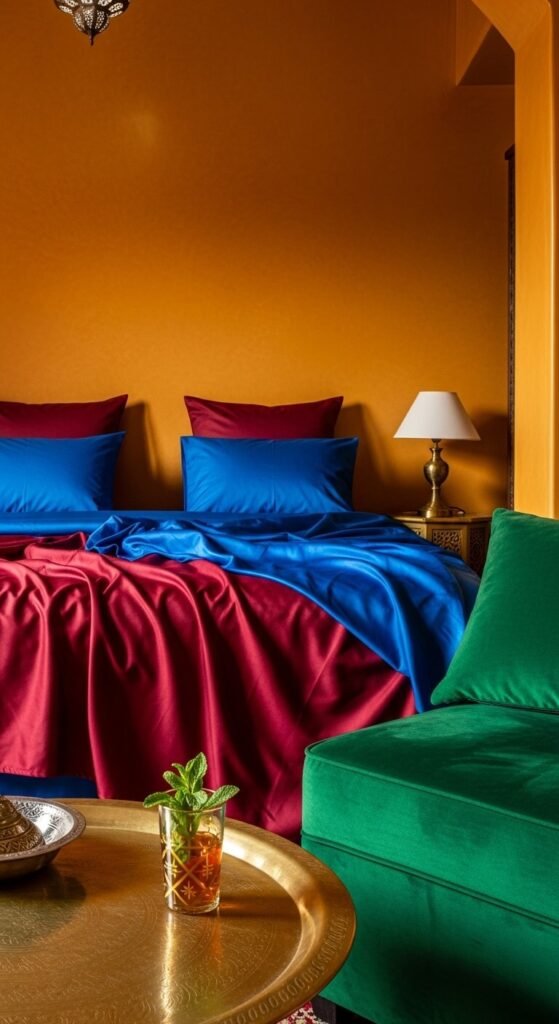
Color does more work in Moroccan design than anything else.
Forget whites and grays. The Moroccan palette runs deep: saffron yellow, burnt sienna, cobalt blue, forest green, and rich burgundy. You don’t have to repaint every wall. Start by swapping your bedding to deep jewel tones. Add a terracotta or mustard throw blanket. Toss two cobalt blue pillows on the bed. These small color shifts, combined, create a completely different room atmosphere. A single accent wall in burnt orange costs about one quart of paint — roughly $12 — and changes everything about the space.
7. Embroidered Throw Pillows
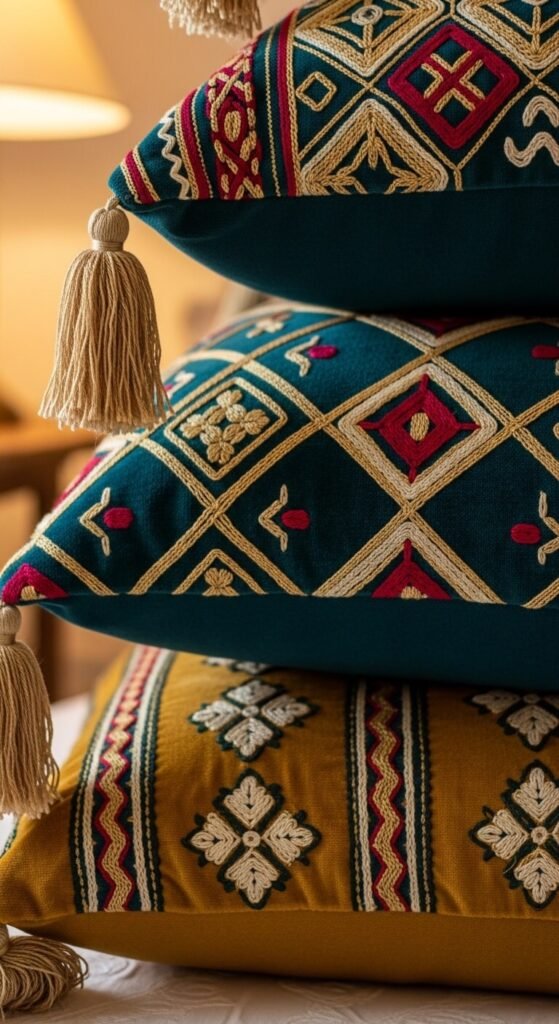
Pillows are your fastest, cheapest Moroccan upgrade.
Embroidered throw pillows with geometric or floral patterns in metallic thread are everywhere right now — HomeGoods, TJ Maxx, and online Moroccan import shops all carry them. Look for patterns called tarz or tazerzit embroidery for authentic style. Mix sizes: two large square pillows at the back, two medium ones in front, and a small bolster at the edge. Mix patterns freely — the layered look is intentional in Moroccan design, not accidental. A set of four embroidered pillows can cost as little as $30 total.
8. Mashrabiya Room Divider
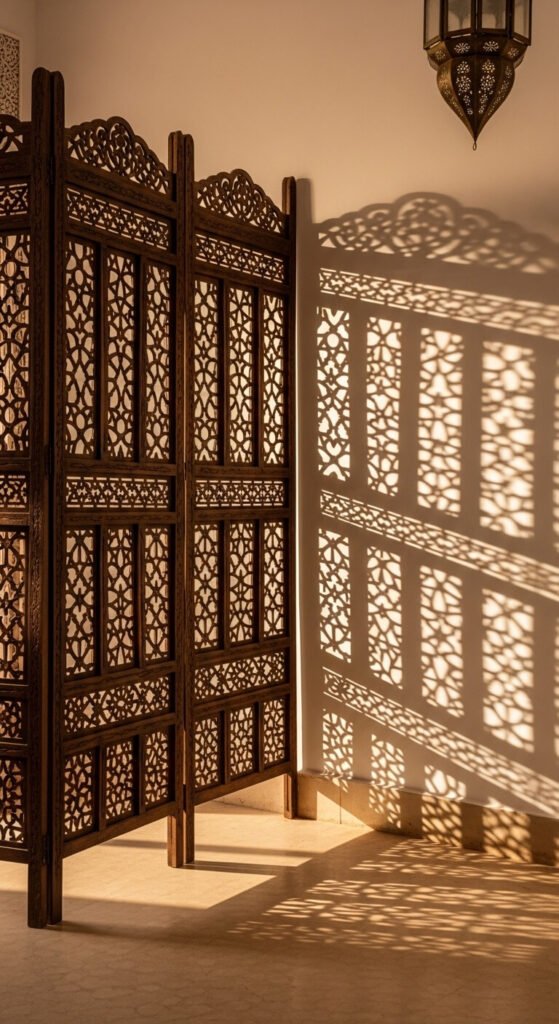
A mashrabiya screen adds privacy, pattern, and shadow all at once.
Mashrabiya is the traditional Arabic term for carved wooden lattice screens. In a bedroom, they work as room dividers, headboard alternatives, or simply as decorative wall art. The light filtering through the carved openings creates moving shadow patterns that shift throughout the day. IKEA’s KALLAX unit with carved wood overlays is a popular DIY version. Or look for laser-cut wooden panels on Etsy starting around $50. Lean one against the wall — no mounting hardware needed. The effect is immediate.
9. Tadelakt-Style Plaster Walls
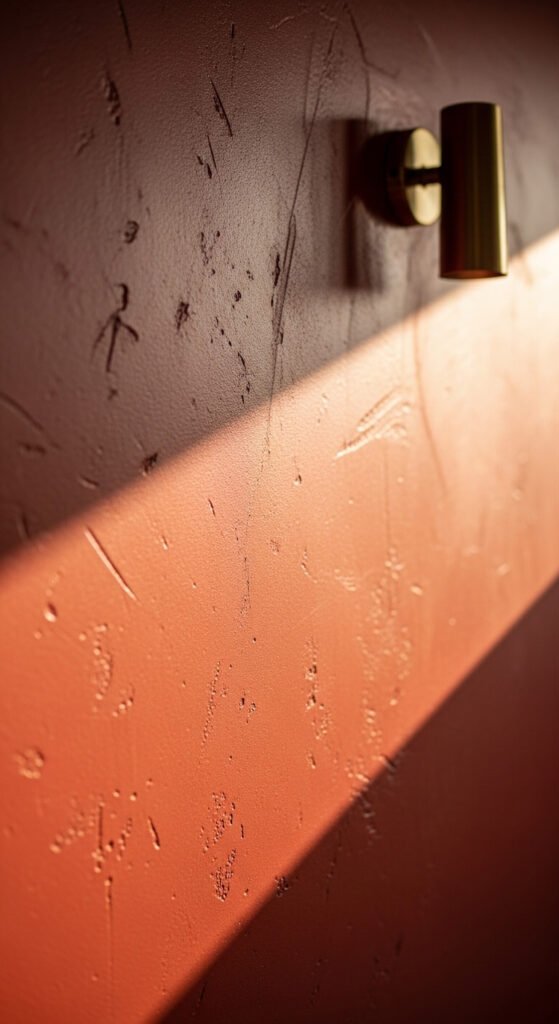
Few finishes feel as ancient and luxurious as tadelakt plaster.
Tadelakt is a waterproof Moroccan lime plaster traditionally used in hammams and riads. It’s polished to a smooth, slightly waxy finish and carries a natural sheen. Hiring a plasterer to do a full tadelakt treatment is expensive, but a DIY version using venetian plaster from Home Depot or Lowe’s ($30–$60 per gallon) achieves a very similar look. Apply in terracotta, warm white, or dusky rose. Use a plastic trowel and circular motions. One accent wall is all you need to set the tone.
10. Brass and Copper Accent Pieces
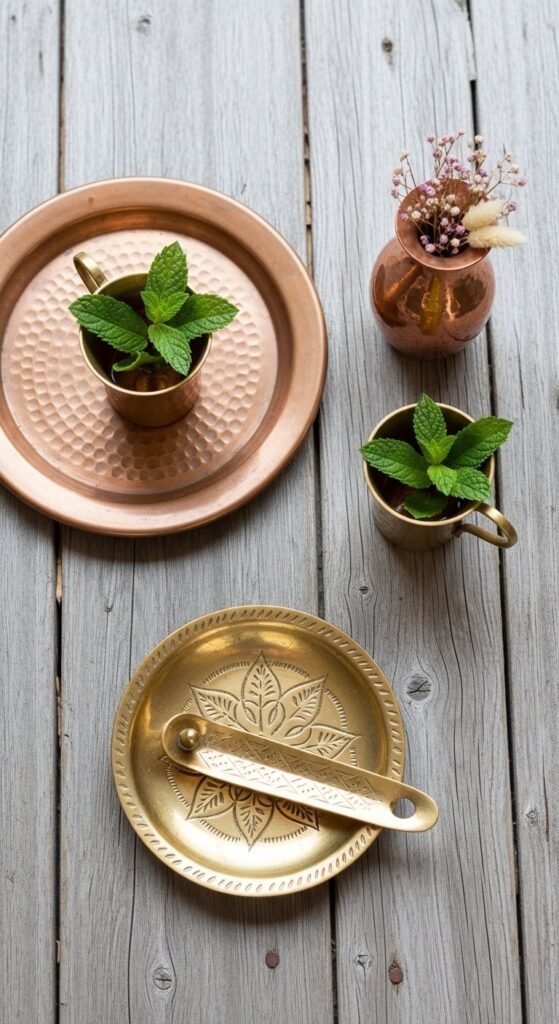
Brass and copper are the metallic backbone of Moroccan style.
Swap out any chrome or silver hardware you have for hammered brass or aged copper. Think drawer pulls, lamp bases, tray tables, picture frames, and candle holders. These don’t need to match — slight variation in finish actually looks more authentic. World Market, HomeGoods, and Etsy carry hammered brass pieces at accessible prices. A brass tray on a side table styled with tea glasses and a small candle captures the Moroccan salon feeling perfectly. A full brass accent refresh can cost under $50 if you shop smart.
11. Silk or Velvet Bed Canopy
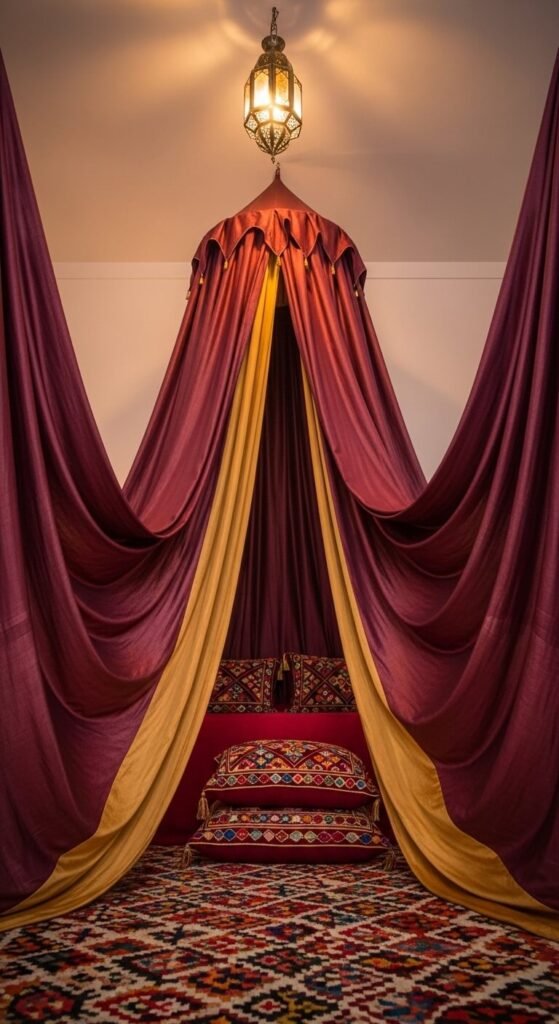
A bed canopy is one of the most romantic gestures a bedroom can make.
Silk or velvet fabric draped from a ceiling hook above the bed transforms the sleeping space into something private and theatrical. You don’t need a four-poster frame. A single ceiling hook and two or three meters of fabric is all it takes. Gather the fabric at the top into a single point, then let it fall freely to either side of the bed. Burgundy, gold, and deep teal are the most Moroccan-feeling color choices. Fabric from a craft store costs as little as $8 per meter. The whole canopy can be done for under $30.
12. Hand-Painted Cement Tile Floors
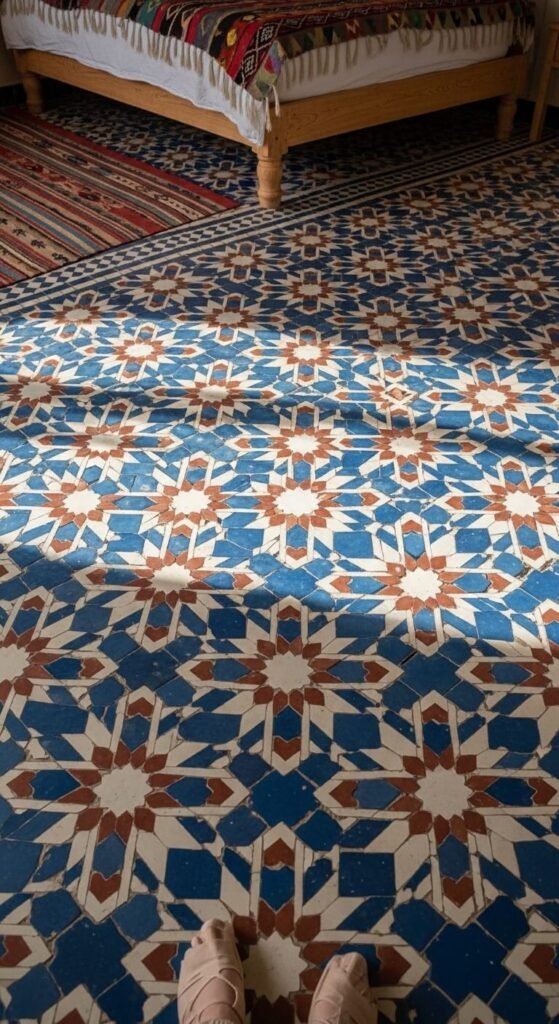
Moroccan floors are as decorative as any wall or ceiling.
Hand-painted cement tiles in star, compass, or fretwork patterns are the authentic choice. Real cement tiles run $5–$15 per square foot installed — a worthwhile investment for a small bedroom. If that’s outside your budget, peel-and-stick vinyl tiles in Moroccan patterns from companies like Quadrostyle or FloorPops start at $2 per tile and go over existing flooring with no adhesive needed. For a bedroom, even covering just the area beneath the bed creates a defined, intentional zone that reads as fully designed.
13. Berber Beni Ourain Rug
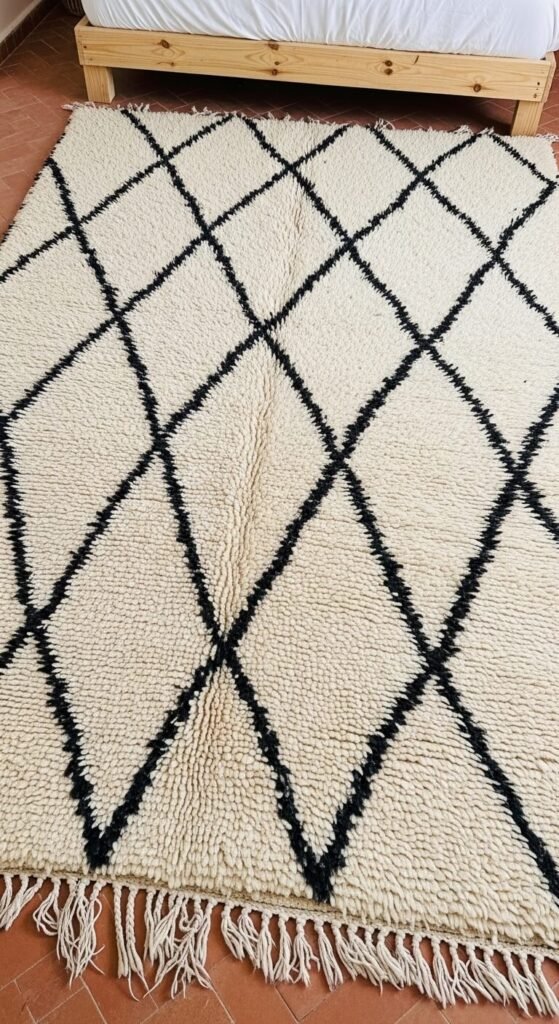
No single rug says Morocco more clearly than a Beni Ourain.
These rugs come from the Beni Ourain tribes of the Middle Atlas Mountains and are hand-knotted from undyed natural wool. The classic pattern is simple: irregular black or dark brown diamonds on a cream background. The thick, shaggy pile makes them feel luxurious underfoot. Authentic pieces start around $200 for smaller sizes on Etsy or eBay. Budget-friendly machine-made versions that capture the look faithfully are available from Amazon and IKEA for $60–$120. Place under the bed with two-thirds showing at the foot for maximum impact.
14. Arched Mirror or Doorway Frame
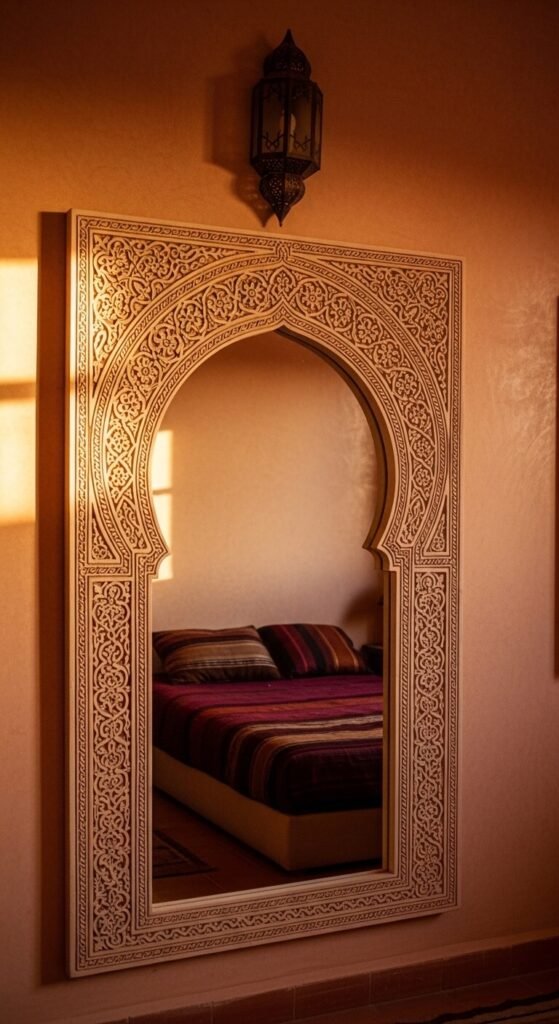
The horseshoe arch is the most recognizable shape in Moroccan architecture.
Arched mirrors with ornate frames bring that architectural language directly into your bedroom. Look for mirrors with pointed or horseshoe-arch frames in carved wood or metalwork at HomeGoods, Anthropologie, or on Etsy. Prices run from $40 for simple styles to $200 for more elaborate carved versions. If you’re feeling ambitious, build an arch surround around an existing rectangular mirror using foam molding and plaster texture paint — it costs about $20 in materials. The arch shape alone transforms the room’s visual grammar.
15. Moroccan Poufs
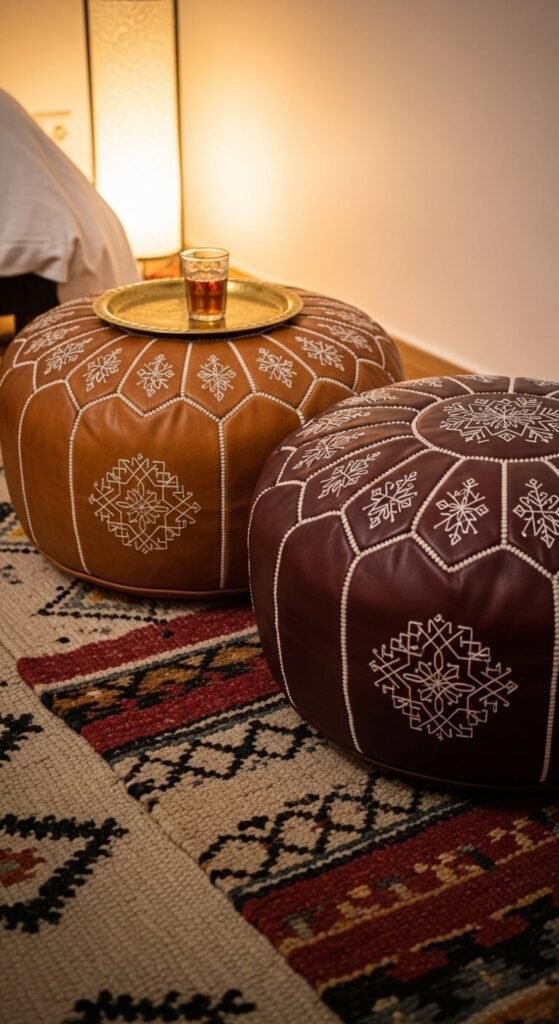
Poufs do more work than their small size suggests.
A leather Moroccan pouf serves as extra seating, a footrest, a side table, or a simple decorative anchor. Traditional ones are hand-stitched from goat leather in caramel, burgundy, or mustard. Authentic poufs arrive flat-packed and need stuffing — use old clothing, foam scraps, or buckwheat fill. They’re available on Amazon and Etsy for $35–$90. Place one on each side of the bed as nightstand alternatives. Top with a small brass tray for candles or a book. They’re functional, beautiful, and genuinely affordable.
16. Hanging Macramé or Woven Wall Art
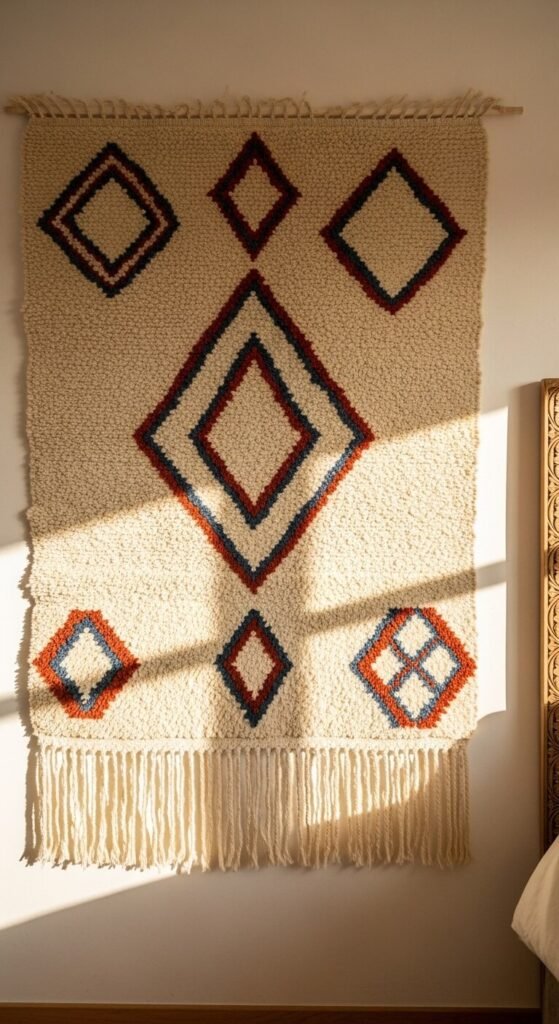
Woven wall textiles add warmth that no paint or print can replicate.
Moroccan wedding blankets (handira) and kilim wall hangings are the authentic choice — look for them at Moroccan import shops or on Etsy for $60–$200. For a budget alternative, macramé wall hangings in cream or earthy tones with geometric knotted patterns read as very Moroccan when styled correctly. Hang one large piece above the bed as a headboard alternative, or arrange three smaller pieces in a vertical grouping on a side wall. The texture they add to a room is disproportionate to their cost.
17. Decorative Stucco or Plasterwork Details
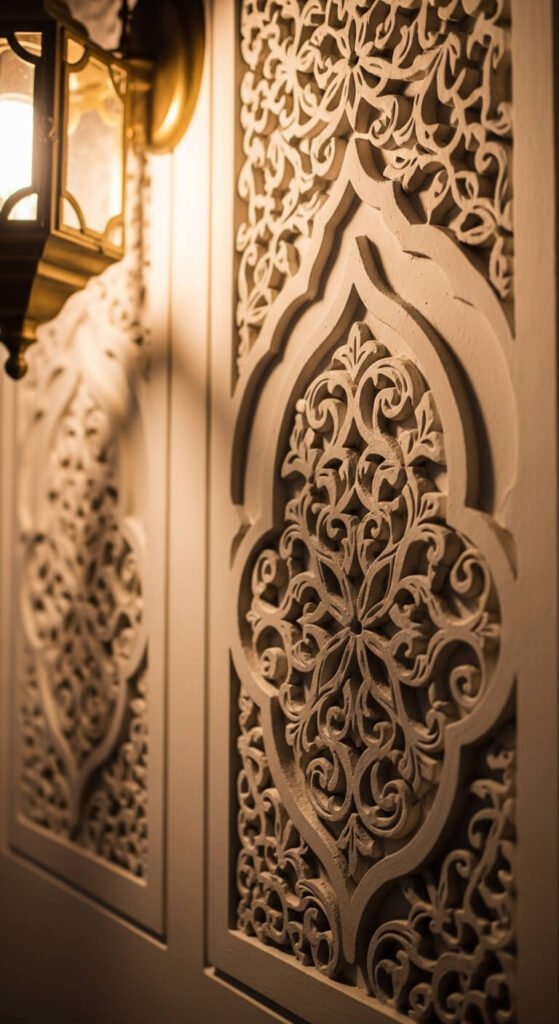
Plasterwork is where Moroccan craft reaches its highest point.
Carved plaster panels, called gypsum tadelakt or jbs, appear in every traditional Moroccan interior — on walls, framing doorways, and forming decorative niches. Reproduction panels in resin or polyurethane are available at architectural salvage stores and online for $20–$60 per panel. These mount directly to the wall with construction adhesive. Position one above the headboard as a decorative frame, or use narrow panels as a border around a window or door. Spray paint them in warm white or aged gold before mounting for the most authentic look.
18. Incense and Fragrance Ritual Corner
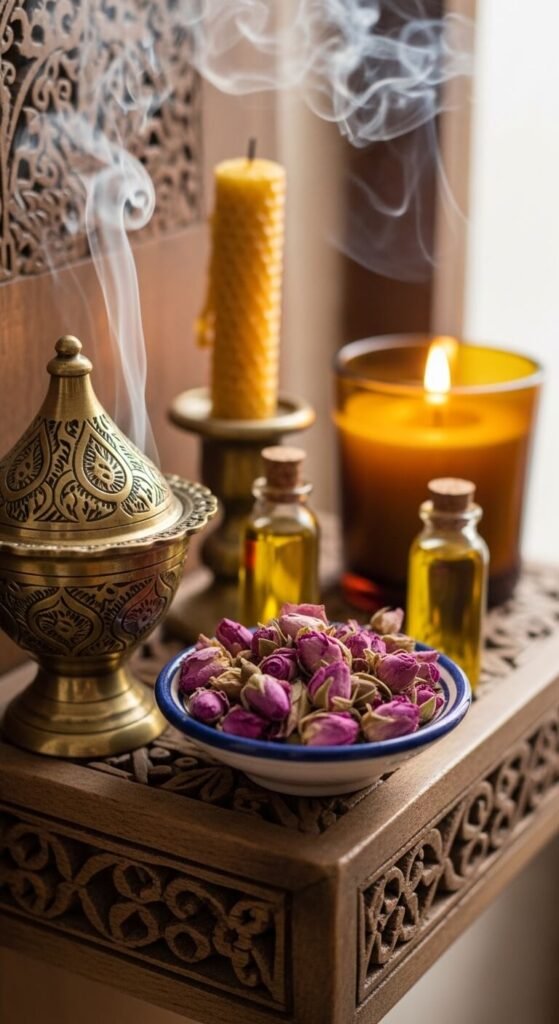
Scent is part of Moroccan interior design — not an afterthought.
Oud, rose water, amber, and argan are the signature fragrances of Moroccan homes. Create a small fragrance corner on a shelf or low table: a brass incense burner, a ceramic bowl of dried rose petals, and a reed diffuser or candle in musk or amber. Oud incense sticks are available at Middle Eastern grocery stores for around $5. A decorative brass incense holder runs $10–$25 on Etsy. The ritual of lighting incense each evening adds atmosphere that no visual element alone can match.
19. Ceramic and Pottery Vases
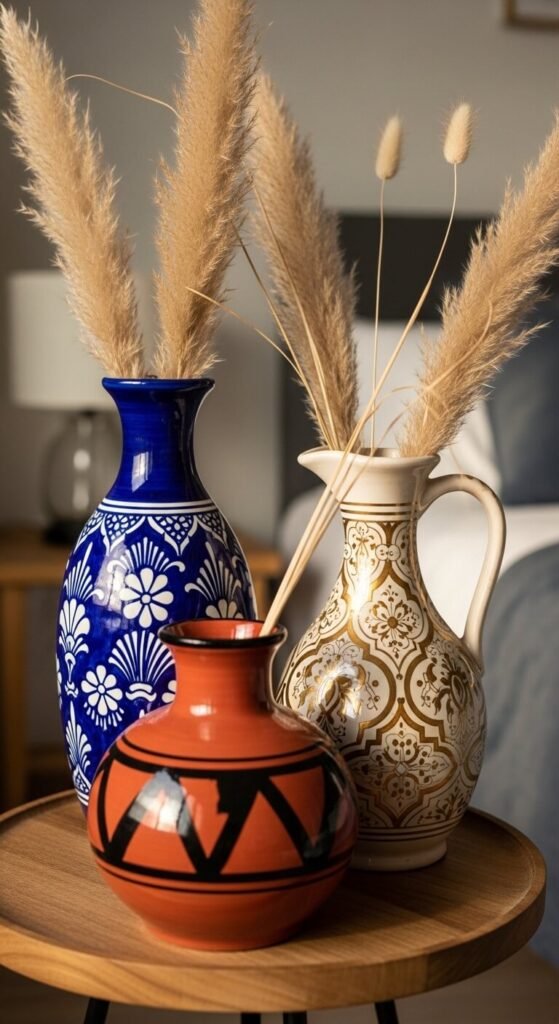
Moroccan pottery has a handmade quality that mass-produced ceramics can’t replicate.
Look for hand-painted Fez pottery — identifiable by cobalt blue patterns on white or cream clay — from Moroccan import shops or Etsy sellers. Group three vases of varying heights on a side table or dresser: one tall, one short, one in between. Dried botanical stems — pampas grass, dried roses, or eucalyptus — suit the aesthetic far better than fresh-cut flowers here. Prices start at $15 for individual pieces. The grouping of three, known as a vignette, reads as styled and intentional rather than cluttered.
20. Geometric Printed Bedding
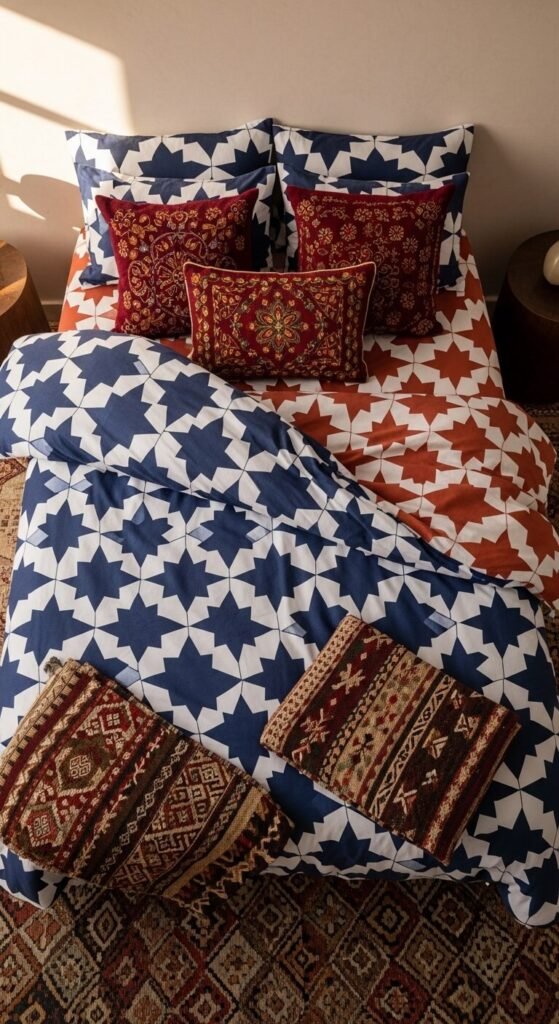
Your bedding is the largest single surface in the room — use it.
Geometric block-print or woven bedding in Moroccan-inspired patterns does most of the stylistic heavy lifting. Look for eight-pointed stars, diamond lattice, or fretwork patterns in deep indigo, terracotta, ochre, or forest green. H&M Home, Anthropologie, and World Market all carry Moroccan-print duvet covers from $40–$90. Layer a plain linen fitted sheet underneath, then add a geometric print duvet on top, with an embroidered or woven throw folded at the foot. Three layers of textile depth read as rich without being complicated.
21. Vintage Brass Tray Table
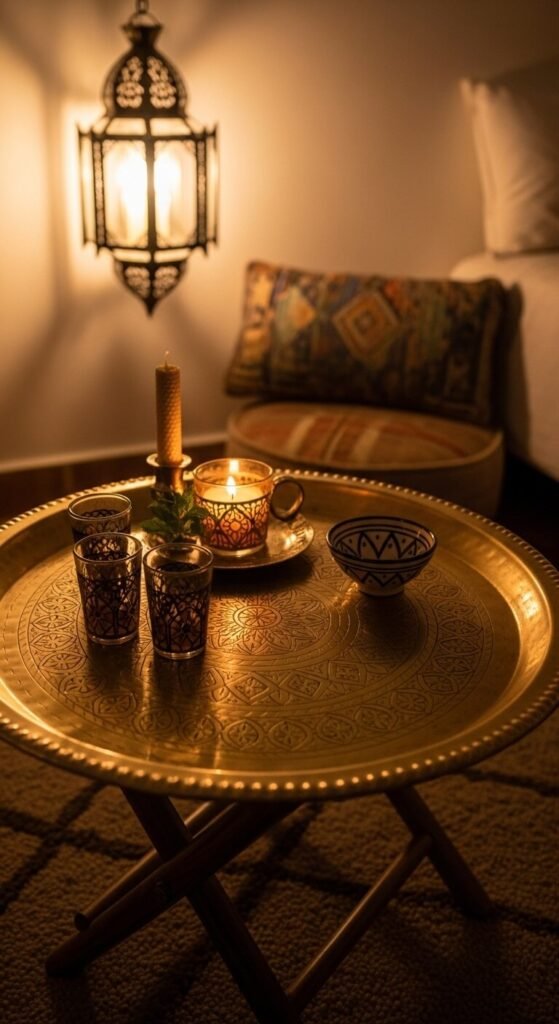
A brass tray table is the most functional piece of Moroccan decor you can own.
The siniyya — a large round engraved brass tray on a folding wooden stand — serves as a side table, a serving surface, and a sculptural object all at once. They’re genuinely useful next to a bed or nestled between floor cushions. Authentic Moroccan siniyya tray tables are available on Etsy from $45–$120 depending on size and engraving. Use it as a nightstand, style it with a candle, a book, and a small ceramic cup. The tray itself can be lifted off and used for serving, keeping it practical as well as beautiful.
22. Woven Rattan Storage Baskets
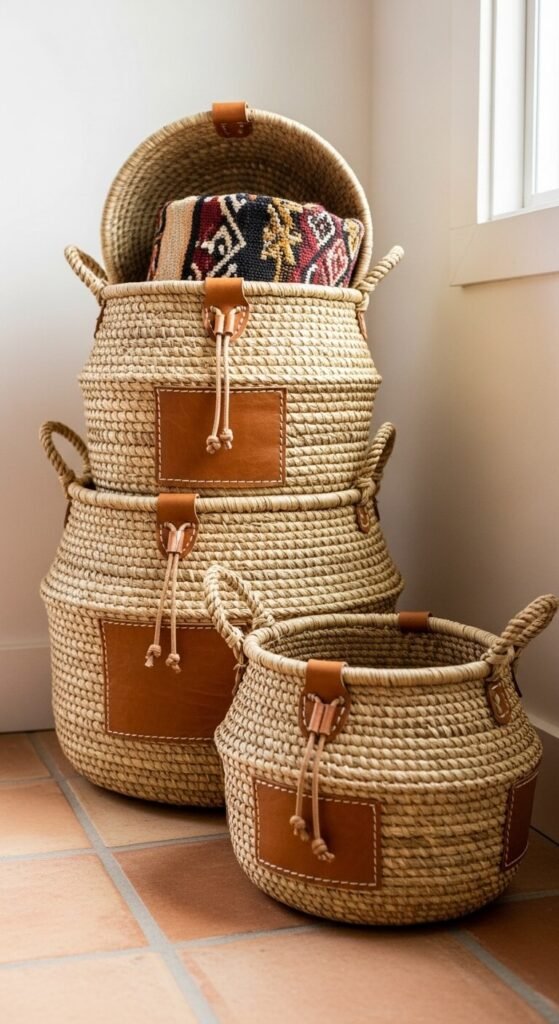
Storage can be decorative without trying too hard.
Hand-woven Moroccan baskets in natural straw, rattan, or leather-trimmed reed are sold at every level of the market — from IKEA’s $8 seagrass baskets to authentic leather-handled Moroccan hamper baskets at $60+. Use them for extra blankets, spare pillows, or clothing overflow. Stack two or three in a corner for visual interest. The natural material texture plays beautifully against tile floors and plaster walls. Add a simple leather tag label for a small personal touch. These are functional, zero-clutter storage tools that also happen to look great.
23. Star-Shaped Ceiling Medallion
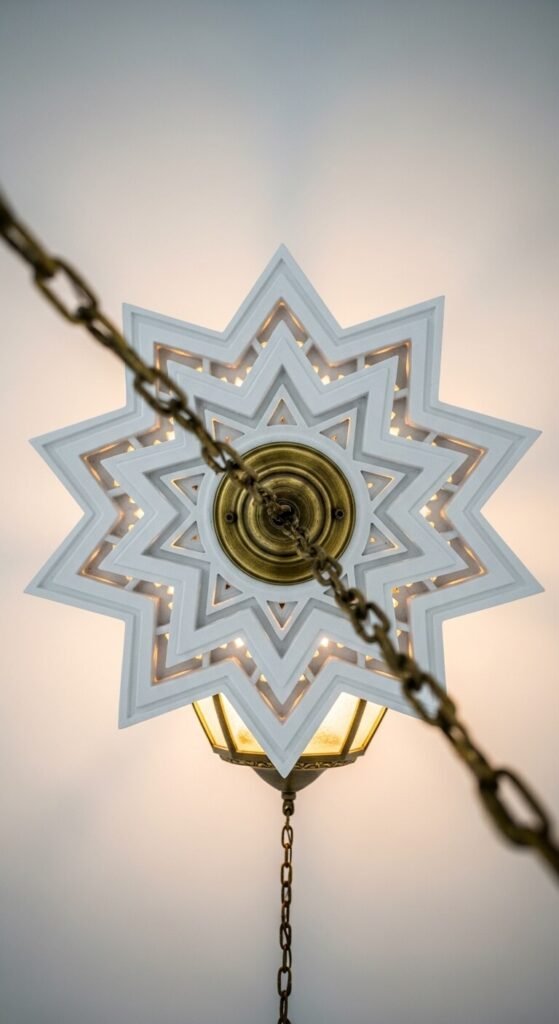
Look up — your ceiling is a missed opportunity in most bedrooms.
A star-shaped ceiling medallion framing your light fixture is a deeply Moroccan touch. The eight-pointed star, called the khatim, appears throughout Islamic geometry and Moroccan craft. Polyurethane and plaster medallions in star and geometric patterns are available at home improvement stores and on Amazon for $15–$50. Install them with ceiling medallion adhesive — no professional help needed. Pair with a hanging brass lantern for the full effect. Paint in warm white, aged ivory, or gold. The ceiling becomes a fifth wall worth looking at.
24. Window Treatments with Tassels
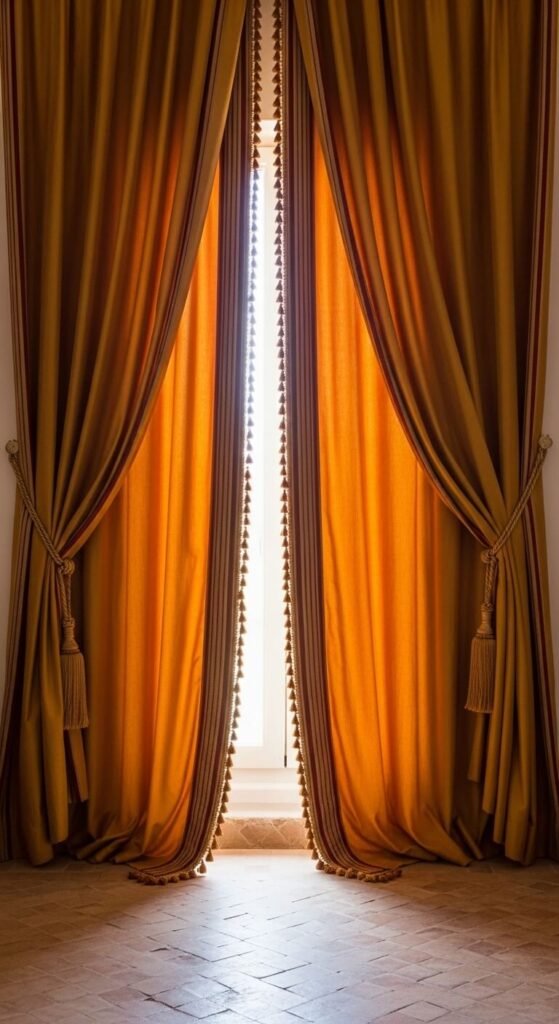
Curtains with decorative trim signal Moroccan interiors immediately.
Choose curtains in solid jewel tones — deep amber, cobalt, or forest green — and add tassel trim along the edges yourself. Tassel trim is sold by the yard at fabric stores for $3–$8 per yard and glues or sews on easily. Floor-length panels that pool slightly on the floor feel luxurious. Add twisted cord tiebacks with tasseled ends to hold them back during the day. IKEA’s plain linen curtain panels are a perfect base to customize. This small trim addition costs under $20 and transforms a plain curtain into something that looks custom-made.
25. Geometric Painted Ceiling
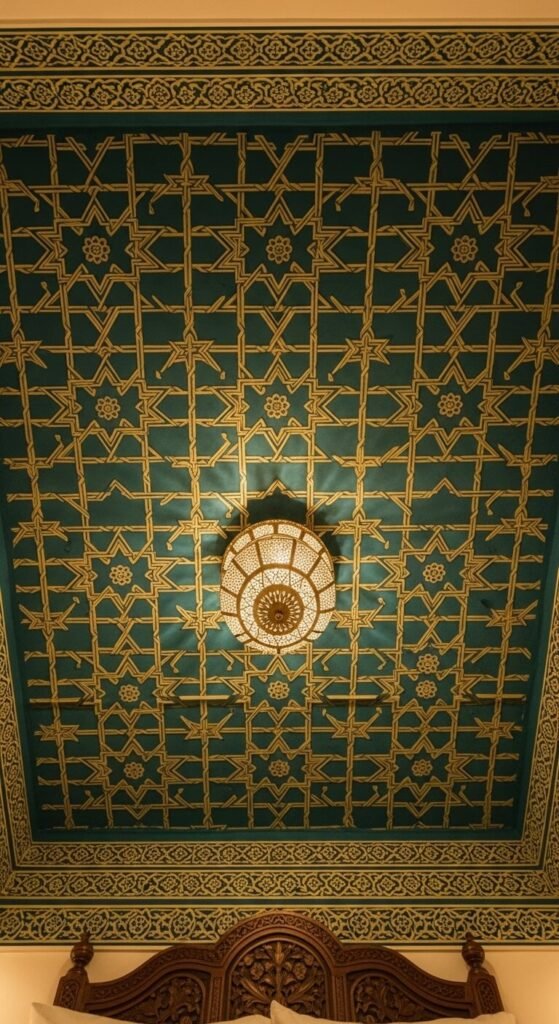
A painted ceiling is bold — and completely reversible with the right primer.
Geometric painted ceilings are a signature feature of Moroccan riads. You don’t need to be an artist. Tape off a simple star or diamond grid pattern using painter’s tape, then paint the alternating sections in a contrasting color. Deep teal on a warm white ceiling, or terracotta diamonds on aged ivory — both read as Moroccan. Use a sample pot of paint ($4–$6 at most hardware stores) for the accent color. Plan the grid on paper first, measure carefully, and tape slowly. The result looks far more complex than the process.
26. Leather or Suede Floor Cushions
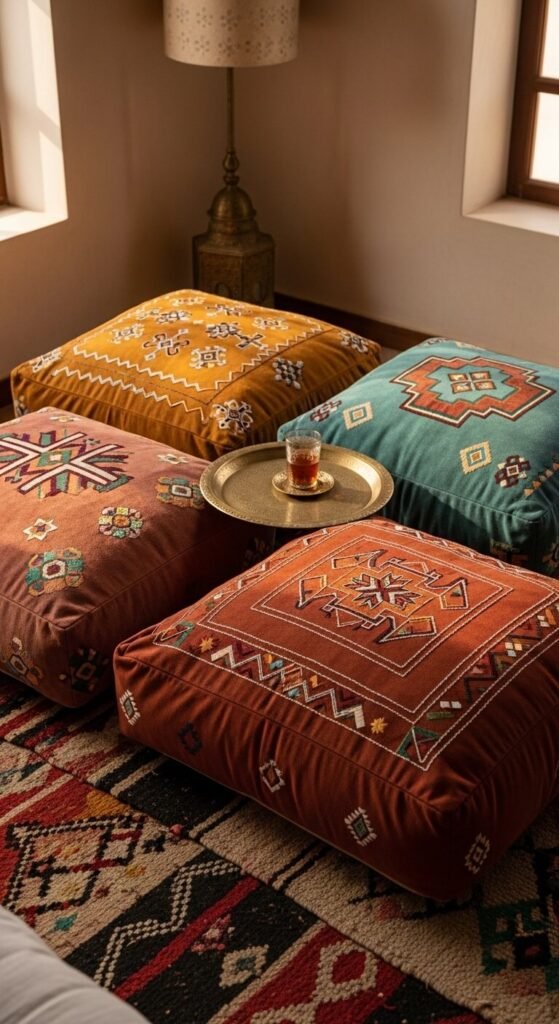
Floor cushions invite the room to be used differently.
In Moroccan homes, sitting and lounging at floor level is completely normal. Large leather or suede floor cushions cluster around a low tray table to create a seating area that needs no chairs. Look for cushions in rust, mustard, teal, and burgundy — mix colors freely. Pottery Barn, World Market, and HomeGoods carry floor cushions from $20–$60 each. Making your own from upholstery fabric and foam filling costs about $15 per cushion. Place four around a brass tray table in a bedroom corner and you have a fully functional seating nook.
27. Hand-Knotted Silk or Wool Throw
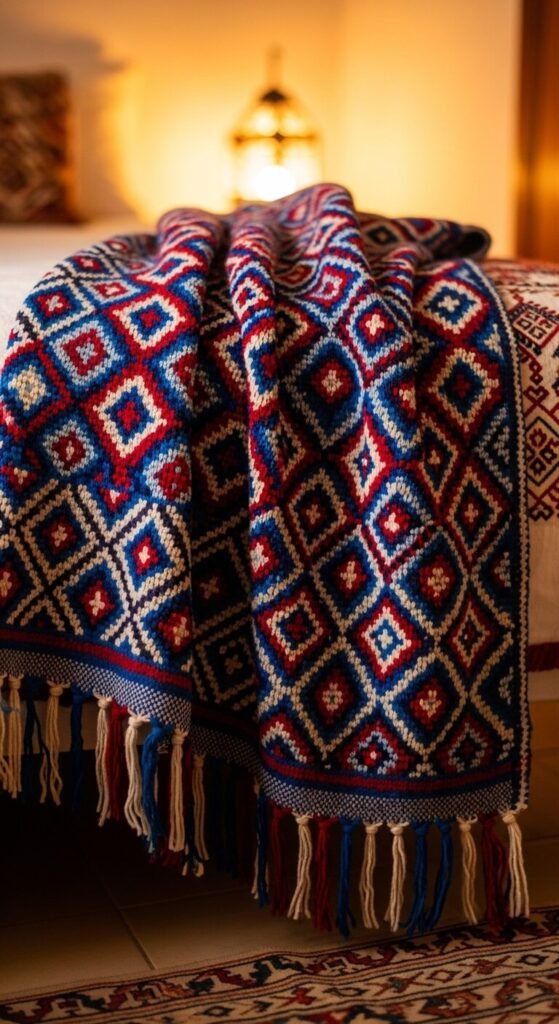
A quality throw blanket works harder than almost any other textile in the room.
Hand-knotted wool throws in tribal diamond patterns function as bed layering, wall art, or draped furniture covers. The fringe ends are a characteristic Moroccan detail — look for pieces where the fringe is knotted rather than machine-cut. Authentic Moroccan wool throws are available from import shops and Etsy sellers for $40–$150. Use one draped asymmetrically across the foot of the bed, one thrown over a chair back, and another folded in a basket. The more throws in a Moroccan room, the warmer and more layered the atmosphere becomes.
28. Clustered Candlelight Arrangements
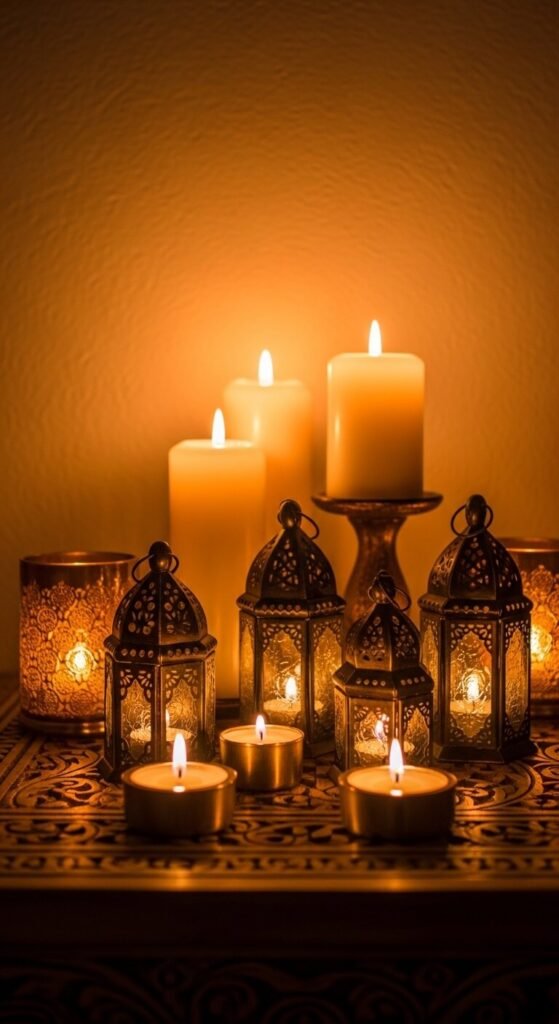
Nothing creates atmosphere faster than candlelight — and nothing is more Moroccan.
Cluster candles and lanterns together on a low wooden surface, a fireplace mantel, or a floor corner. Combine heights: two tall pillar candles, three small tea light holders in brass or ceramic, and one small lantern. Flameless LED candles in amber tones work just as well and are far safer for a bedroom. Look for LED candles with a realistic flicker setting. A full clustered arrangement of five to seven pieces costs $20–$40 assembled from HomeGoods or IKEA. The warm pooling light they create in the evening is the single fastest way to change a room’s mood.
Conclusion
A Moroccan bedroom doesn’t happen all at once — and it’s better when it doesn’t. The most authentic-feeling rooms in this style are built gradually, piece by piece, the way any well-traveled home accumulates character over time. Start with one element that genuinely excites you: a carved wooden headboard, a brass lantern, a pile of embroidered pillows. Let the room tell you what it wants next. None of these 28 elements require a contractor, a large budget, or a complete overhaul. Most of them cost less than a dinner out. The real investment is attention — to texture, to light, to color, and to the quiet pleasure of a room that feels like somewhere worth being.