Ever walk into a beautifully styled room and feel like something just clicks — but you can’t quite put your finger on why? Chances are, the secret is hiding in plain sight: the accessories are grouped in odd numbers. It’s one of the oldest tricks in an interior designer’s playbook, and once you see it, you can’t unsee it.
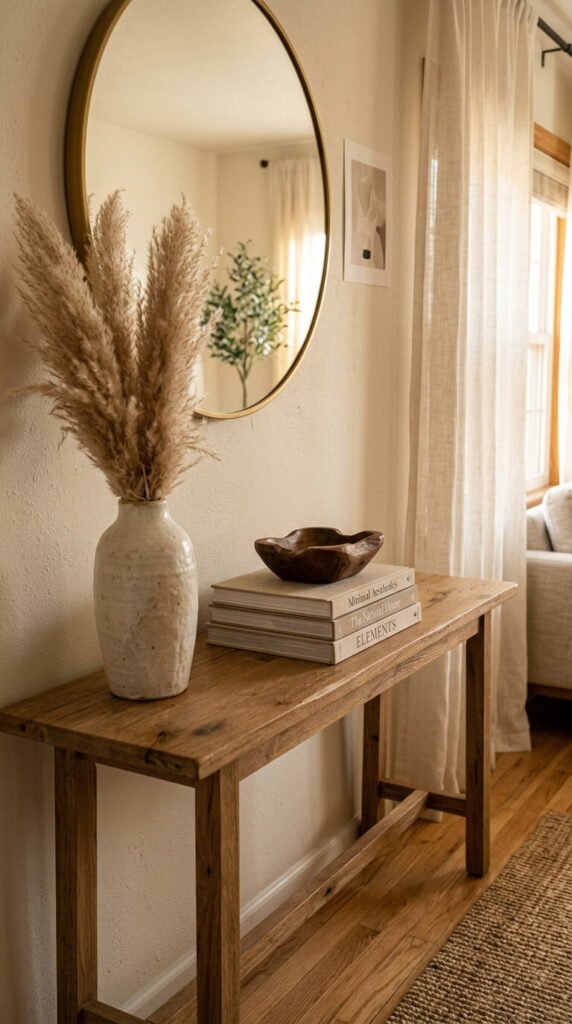
The rule of odds isn’t magic — it’s psychology. Our brains find perfectly even groupings a little too tidy, a little too expected. Odd numbers create visual tension and movement, giving the eye somewhere to travel. The result? A space that feels curated, intentional, and alive.
Why Odd Numbers Work (The Science Behind the Style)
Designers and artists have relied on the rule of odds for centuries — from Renaissance paintings to modern interiors. Here’s why it works:
- Even numbers feel static. Two identical vases side by side create symmetry, which reads as formal and finished — with nowhere to look next.
- Odd numbers create a focal point. With three or five objects, the eye naturally finds the center piece and then explores outward.
- Asymmetry signals intentionality. A perfectly matched pair looks like you bought a set. Three mismatched pieces look like you chose each one.
The sweet spot? Groups of three and five. Groups of seven can work on larger surfaces like bookshelves or mantels, but three is the golden number for most surfaces.
How to Build Your First Odd-Numbered Grouping
Step 1: Vary the Heights
Start with three objects and make sure no two are the same height. Think of it like a skyline — tall, medium, and low. This variation is what gives a grouping its visual rhythm.
- Tall: a vase, candlestick, or sculptural lamp
- Medium: a decorative object, small plant, or framed photo
- Low: a tray, stack of books, or small bowl
Step 2: Mix Textures and Materials
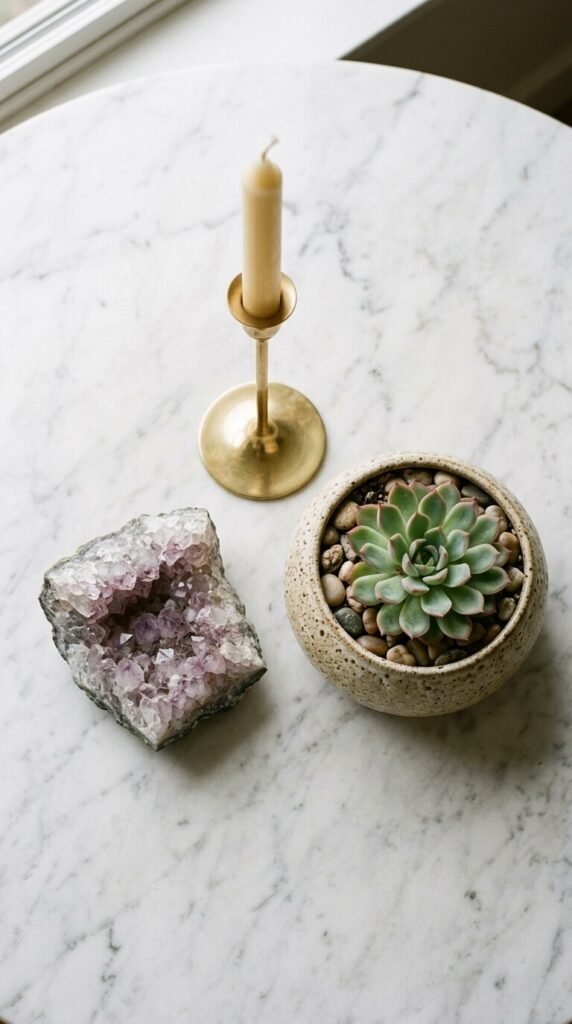
Height variety draws the eye up and down. Texture variety keeps it engaged. Try pairing:
- Something smooth (glass, lacquered ceramic) with something rough (woven basket, raw wood)
- Something matte with something that catches the light (metal, mirrored surface)
- Something organic (a plant, driftwood, dried botanicals) with something man-made
The contrast is what makes the whole grouping feel considered rather than collected.
Step 3: Stay in a Loose Color Story
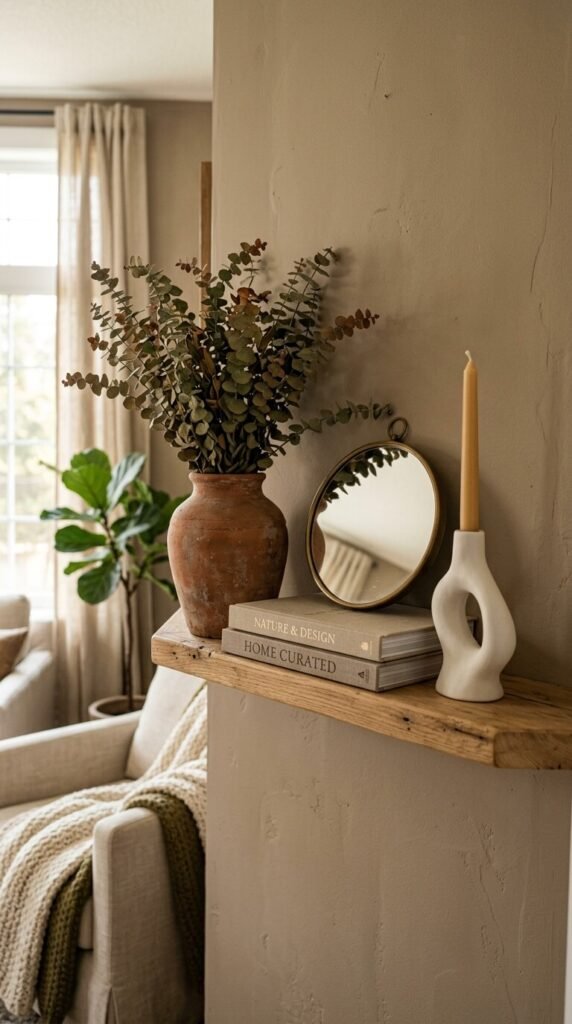
You don’t need a perfectly matched palette — in fact, you shouldn’t have one. But your group should share a thread: a warm undertone, a neutral base, or one repeated accent color.
Example: A terracotta vase, a natural linen-wrapped book stack, and a small brass bowl all speak different languages — but they’re having the same conversation.
Applying the Rule to Different Surfaces
On a Coffee Table
Use a tray to anchor your group of three. The tray acts as a visual “frame” that keeps things from looking scattered. Try: a candle, a small plant, and a beautiful object you love.
On a Bookshelf
This is where groups of five shine. Break up your books with objects at irregular intervals — a small vase here, a framed photo there. The books become part of the grouping.
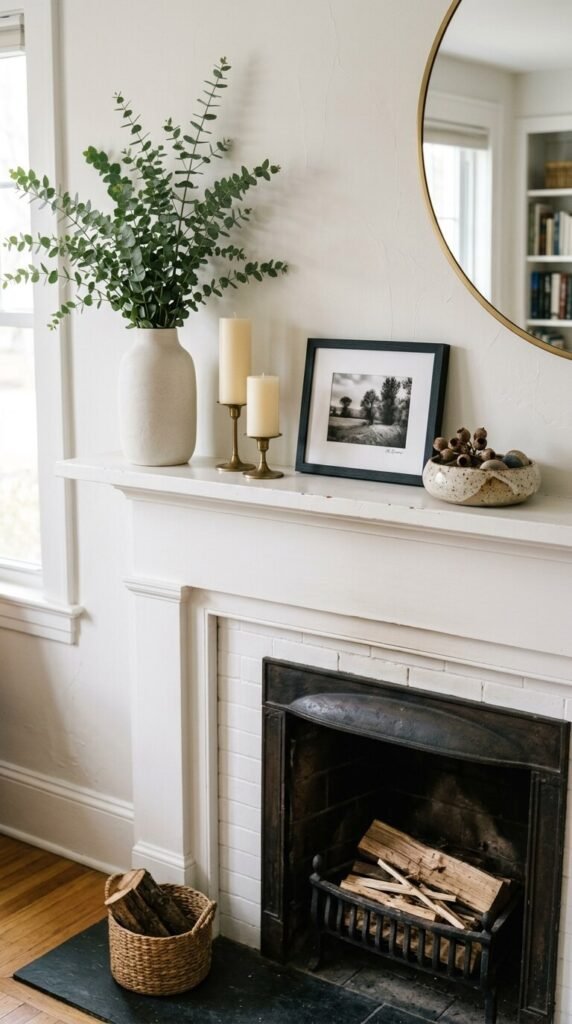
On a Mantel
Go asymmetrical. Don’t center everything. Let your tallest piece anchor one side and let smaller items trail across — it feels organic and editorial rather than staged.
Common Mistakes to Avoid
- Matching too perfectly. If everything came from the same collection, it’ll look like a store display.
- Ignoring negative space. Leave room to breathe. Overcrowding kills the effect.
- Forgetting function. Style should coexist with how you actually live. A beautiful tray with three objects still works as a landing spot for your keys.
The Takeaway
The rule of odds is one of those design principles that feels almost too simple — until you try it and suddenly your surfaces look like they belong in a magazine. Start with three objects on your next open surface, vary the heights, mix the textures, and watch the whole room shift.
Save this article and give it a try this weekend — then tag your styled shelfie so we can see your groupings in action! ✨